Overview
DataVault was born during a 48-hour hackathon where our team set out to solve a critical challenge in today's digital landscape: how to give individuals and organisations absolute control over their data. In an era where privacy is routinely compromised, we built a system that lets users decide who sees what, while ensuring immutability and trust through blockchain.
What started as a hackathon experiment quickly turned into a working prototype for decentralised data management, earning us 2nd place among several forward-thinking teams.
Team
Cloudstech
Product design & engineering
Duration
1 week
October 2025
Tools
- Next.js
- Solidity
- Flutter
- Figma
- Miro
Visuals
Brand, secondary and tertiary colours
#30DF00
Primary
#000000
Secondary
#EEEEEE
Tertiary
Typography
Helvetica Now Display
Aa
ABCDE abcde 12345 #$%&
Project snapshot
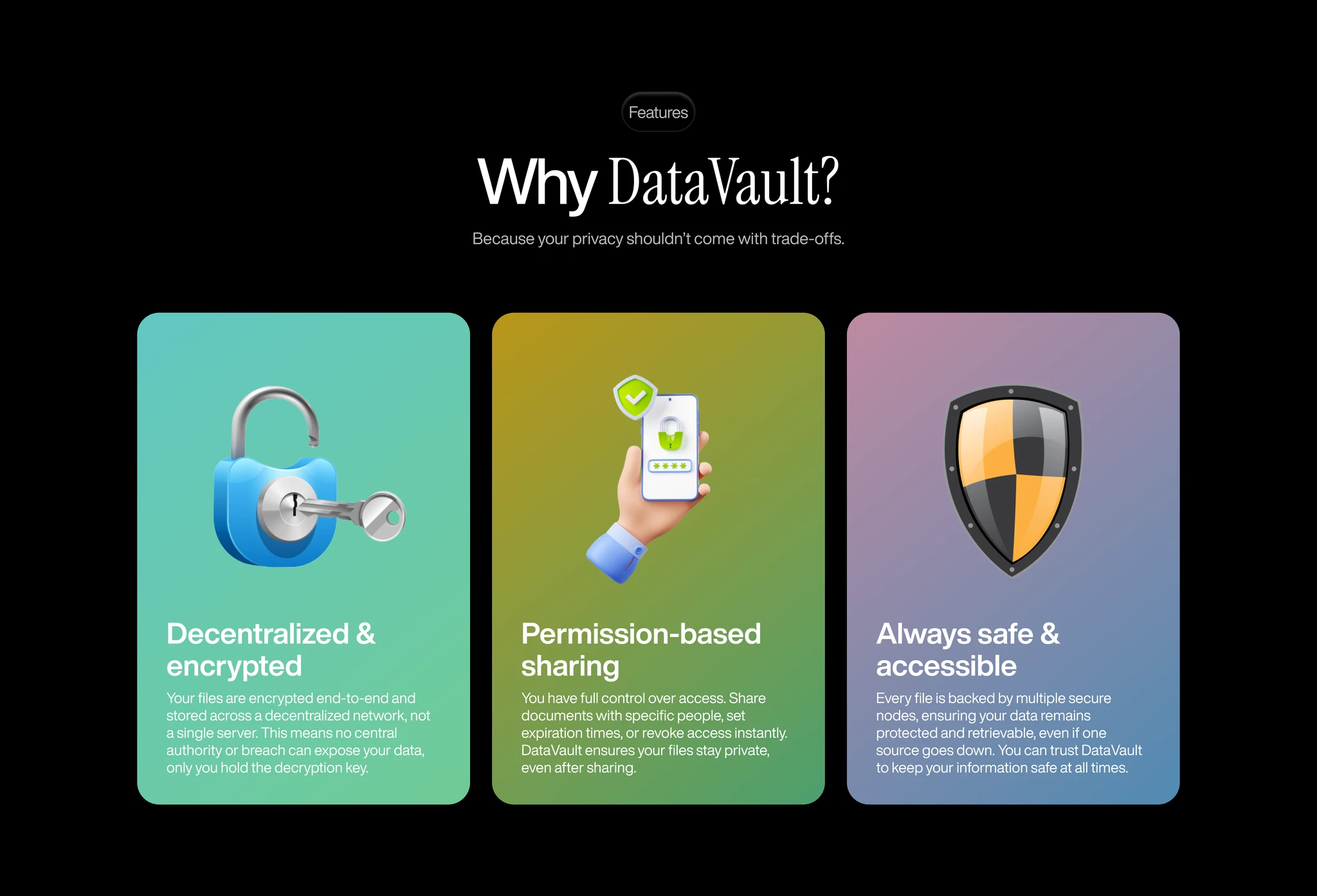
Imagine Google Drive, but instead of your files living on Google's servers, they live in an encrypted vault only you can open. DataVault doesn't just store your data — it protects your privacy, verifies every access transparently, and works across any sector, not just file storage.
The problem
The brief was to use the BlockDAG chain as the backbone for a secure data transfer platform usable in any sector. It had to be NIST/ISO compliant by construction and protect data to cyber-security standards, with access limited to the holder of the wallet's private key or to public keys the holder has explicitly granted.
The canonical example we kept coming back to: a medic at an accident site who needs a victim's medical records immediately, and should be able to get them — but only for as long as the emergency lasts.
The solution
We designed DataVault to give users total control over their personal and professional data — not just to store it, but to decide exactly who can access it, when, and for how long.
Instead of relying on centralised servers or unsecured file links, DataVault combines end-to-end encryption with blockchain-based permissions, so every action from upload to access is transparent, auditable, and user-owned.
For individuals that means sharing health records, IDs, or contracts without worrying about leaks. For businesses it means secure client collaboration, legal compliance, and provable data integrity — all on decentralised infrastructure.
Every file lives on encrypted decentralised storage, access is controlled by wallet-based authentication, and every interaction is logged immutably on the BlockDAG network. Privacy isn't a setting here; it's built into the system.
Impact highlights
Ownership that actually holds
Files are encrypted on the client before they ever leave the device, so the storage layer never sees plaintext and no operator can hand it over.
Access you can take back
Permissions are on-chain grants, not shared links. Revoking is a transaction, and it takes effect immediately for everyone.
Time-bound by default
Every grant carries an expiry — 24 hours, 7 days — so sharing is intentional and self-cleaning rather than permanent by accident.
A provable audit trail
Who accessed what and when is written to BlockDAG, which is what makes the model viable in healthcare, law, and finance.
Research
Before building, we looked at how existing cloud platforms — Google Drive, Dropbox, iCloud — handle sharing and storage. They make access easy, but they rely on centralised systems where data lives on servers the company controls.
Three gaps came out of that review: users don't truly own their files once uploaded; access rests on passwords and shared links rather than verifiable cryptographic identity; and there is no immutable record of who accessed what, which leaves a trust gap in exactly the sectors that need it most.
Key findings
- Link-based sharing is risky. 73% of respondents admitted to sending files through open links that stayed active indefinitely.
- No true ownership. Once a file is uploaded to centralised storage, users lose control — it is hosted and managed by third-party servers.
- Accidental oversharing. 4 in 10 users have shared files with the wrong recipient or forgotten to revoke access.
- Trust erosion. Professionals in finance and healthcare named compliance exposure and data misuse as their top fear.
- Demand for transparency. Users want to know who opened their files, and when.
Research-led design principles
- User ownership first. Files stay encrypted and user-controlled, never readable by the storage layer.
- Permission-based sharing. Access is granted only through verified blockchain identities.
- Expiry by default. Every grant has an automatic expiration timeline.
- Immutable logs. Every action is permanently recorded on BlockDAG for full transparency.
- Zero-trust design. Even a forwarded file is useless without an authorised wallet.
Personas
Dr. Aisha Bello
Senior physician at a private clinic
Goals
- Manage patient records securely and efficiently
- Stay compliant with HIPAA/GDPR
- Share lab results and prescriptions with patients easily
Frustrations
- Records leak through open drive links
- Collaborators download old or unauthorised versions
- No way to verify original ownership
How it helps
- Records stored in a decentralised, encrypted vault
- Permission-based access for patients and specialists
- Transparent audit logs tracking every use
- Time-limited access for sensitive files
Anne Lingbert
22-year-old freelancer and digital creator
Goals
- Keep client contracts, invoices, and assets secure
- Share work files across phone and laptop
- Control who can reuse her designs or personal data
Frustrations
- Drive and WhatsApp links get forwarded without permission
- Clients reuse her work without payment
- No way to track when portfolio files are accessed
How it helps
- Client files live in her encrypted personal vault
- Access granted to wallet addresses with a set duration
- Every shared file gets a File ID she can revoke anytime
- ID and contract templates in one place, across devices
Research insight summary
Research surfaced a trust gap in file sharing: users take convenience and unknowingly give up control. DataVault closes it by making privacy and simplicity the same action.
Design
01Onboarding
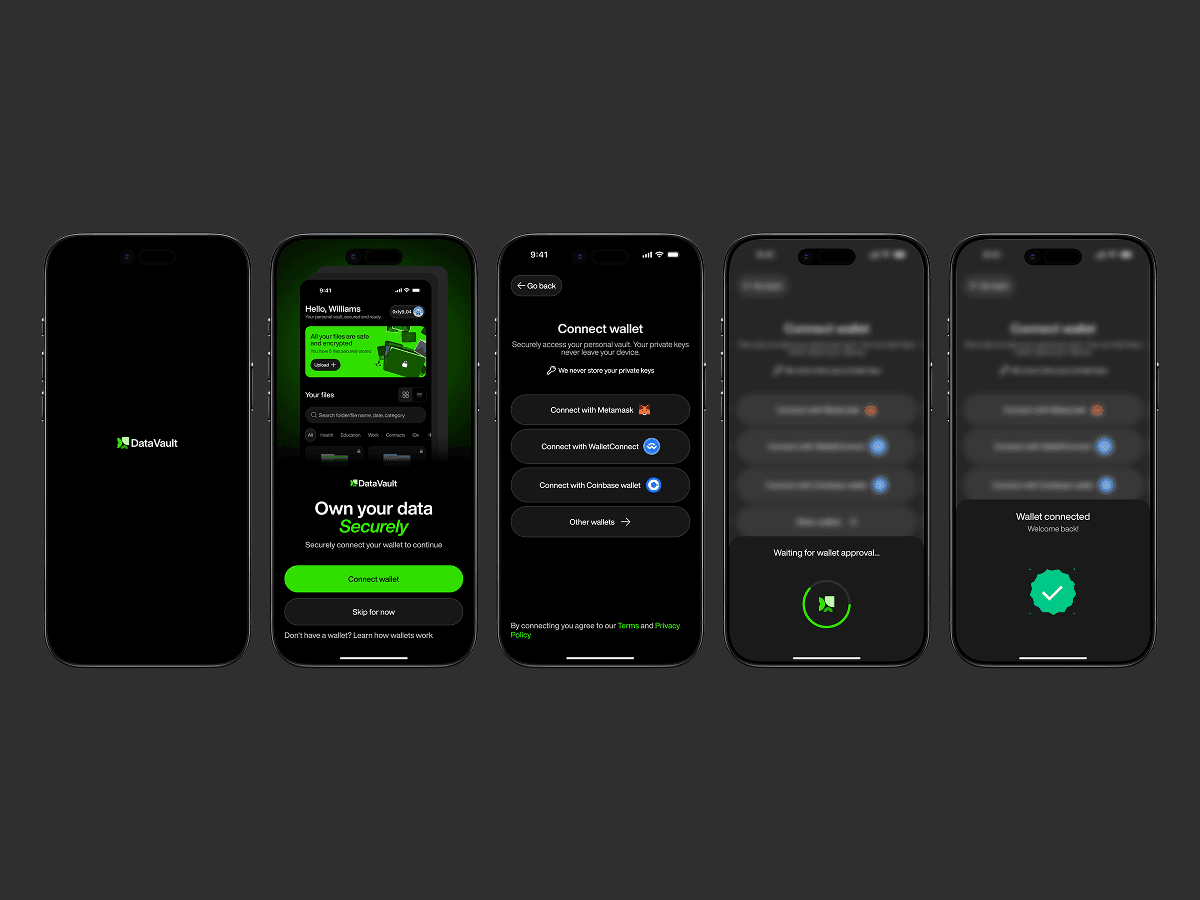
We built onboarding to strip out the friction that usually comes with blockchain apps, so a new user reaches the point of secure, decentralised ownership in under a minute — no seed-phrase lecture, no jargon.
Splash, value proposition, wallet connect, confirmation: four screens, one decision each. MetaMask, WalletConnect, and Coinbase are supported, and the copy is explicit that the private key never leaves the device.
02How it works
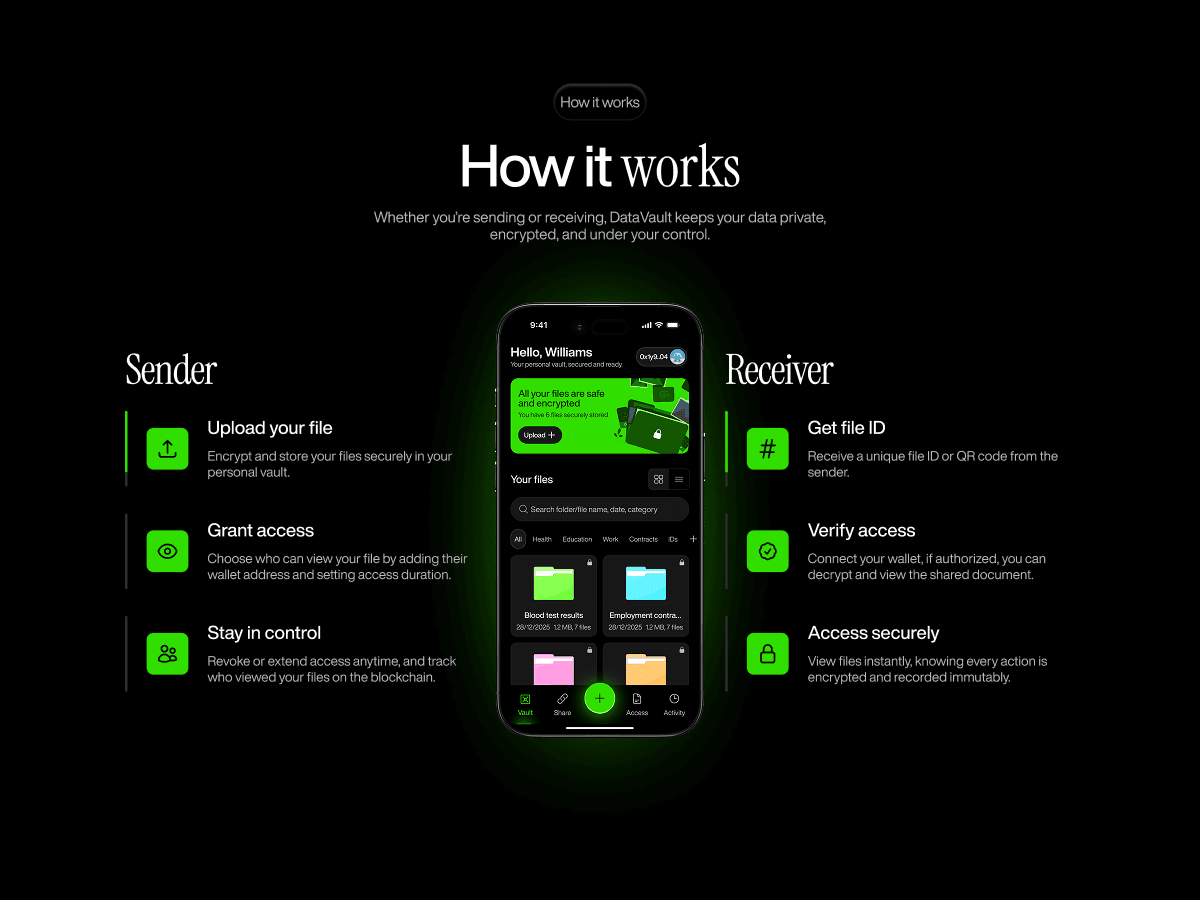
The sender uploads and encrypts a file into their vault, grants access by wallet address, and keeps the ability to revoke or extend at any time. The receiver gets a File ID or QR code, verifies with their own wallet, and decrypts — with every action recorded on-chain.
Making both halves of that exchange legible in one view was what convinced people the model was simple, not exotic.
03The vault
The home screen is the user's command centre. On login they get a confidence-boosting banner — your files are safe and encrypted — which restates the core value proposition before anything else.
Files sit in a modular grid with category filters (Health, Education, Work) and universal search, so nothing gets lost in the decentralised architecture. Access permissions are surfaced as a live list of every person or organisation with a grant, each one revocable or extendable in a single tap.
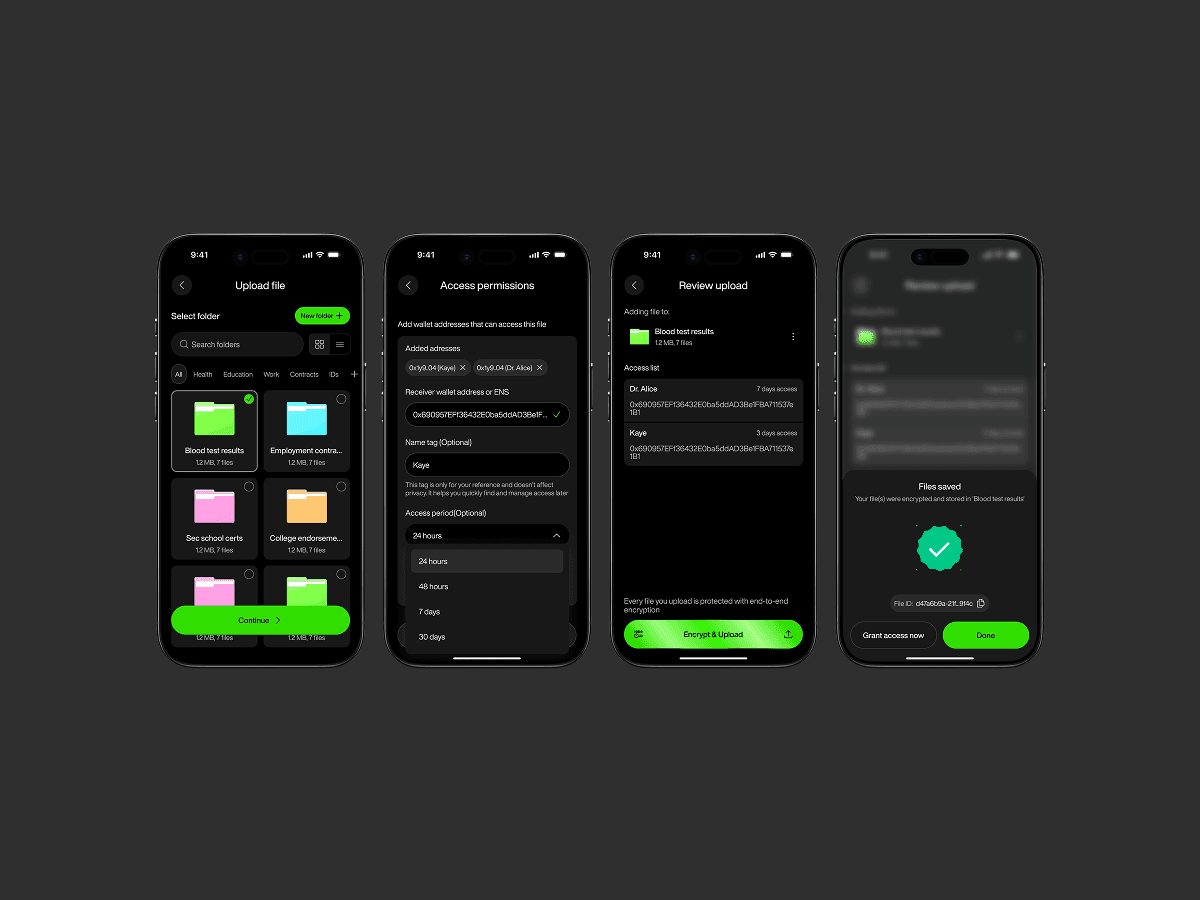
04Upload and share
The core loop is a multi-step flow that puts control and security visibility first. Users select files and pick a destination folder up front, then add recipient wallet addresses or ENS names, tag them for future management, and set the access duration.
A review screen acts as the final checkpoint: what is being uploaded, who can see it, and a confirmation that every file is protected with end-to-end encryption. Encrypt & Upload then runs a visible progress state while the file is encrypted locally and written to decentralised storage.
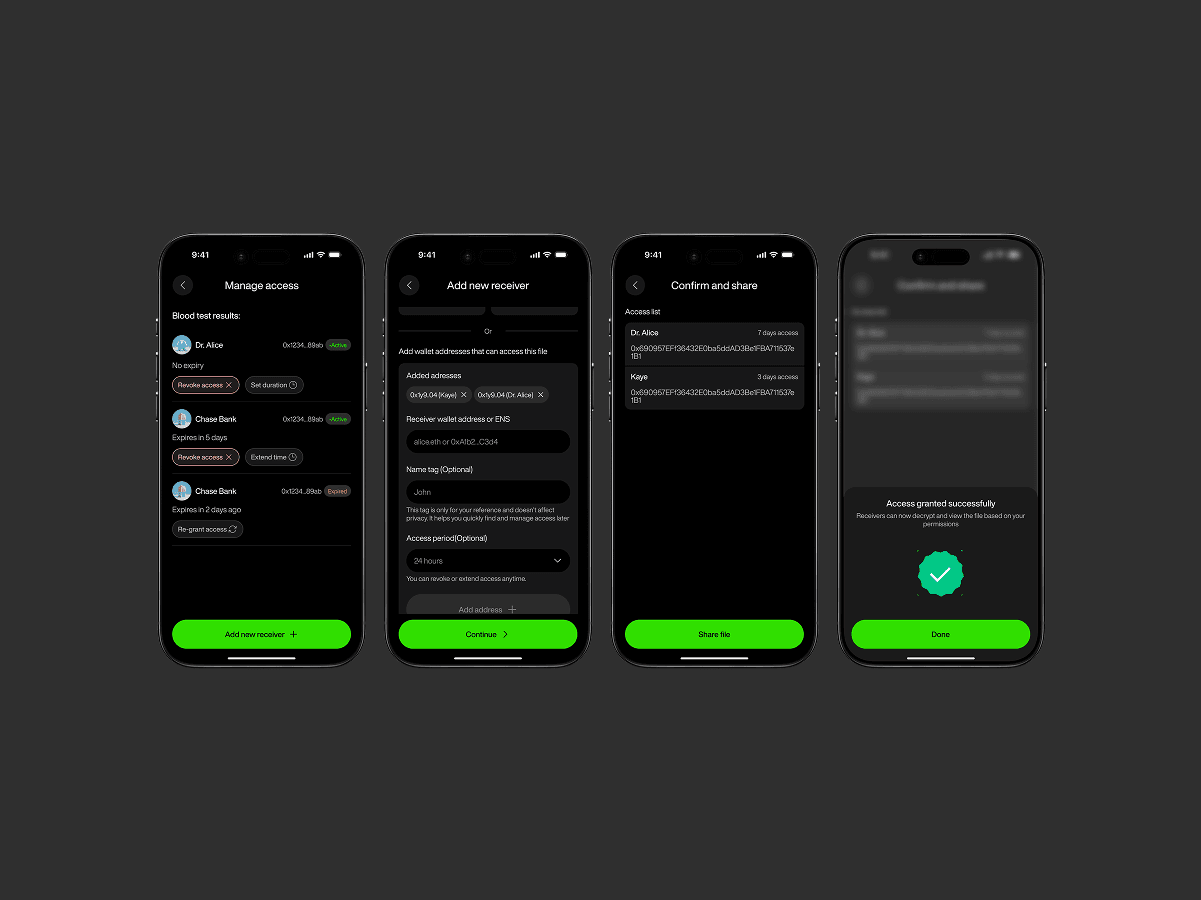
05Adding a receiver
Managing access is a live audit log rather than a settings page. Every current permission is listed with the option to revoke it outright or extend its window.
Adding someone new takes a QR scan or a pasted wallet address, an optional name tag so the entry is readable later, and an access period chosen up front. The change is submitted for wallet approval, which keeps the permission itself decentralised rather than something our server asserts.
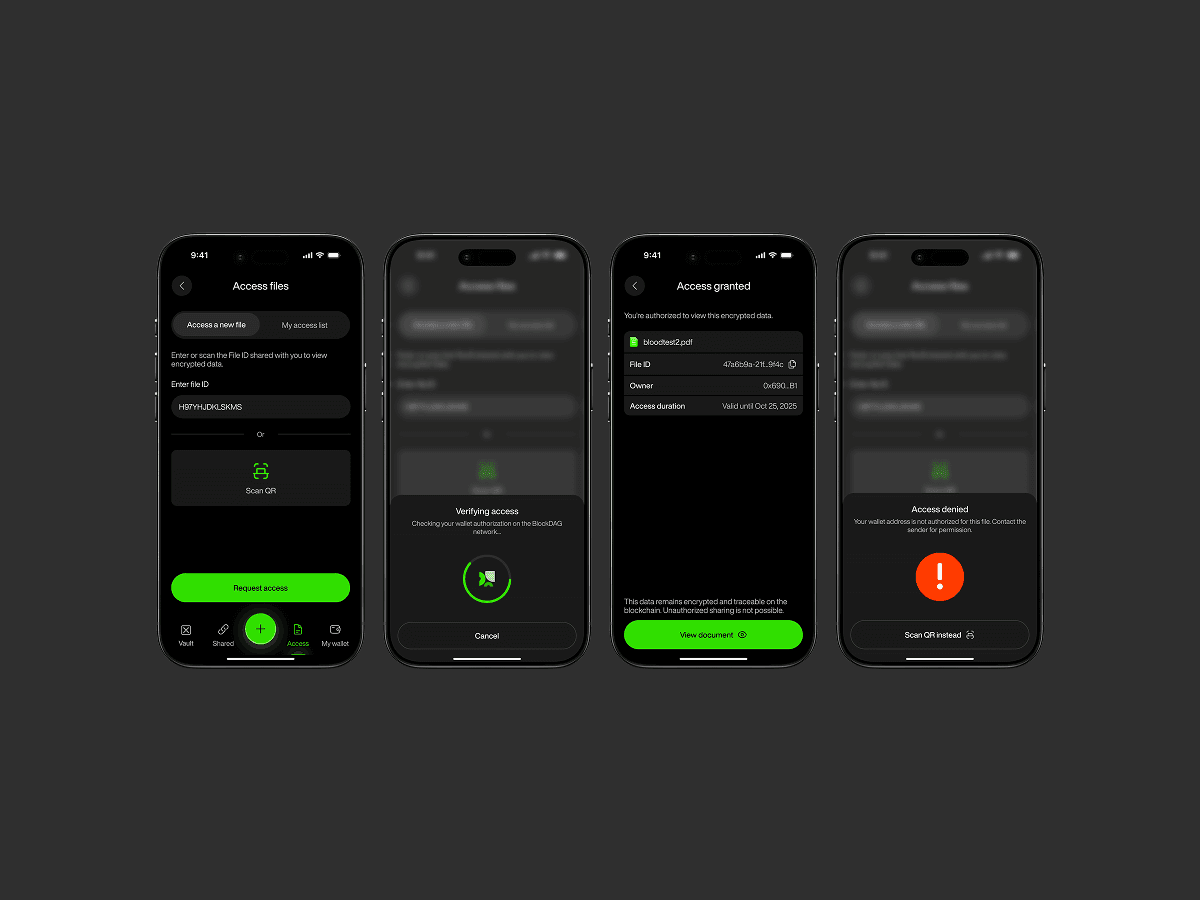
06Access and audit
For a recipient, opening a shared file starts with a File ID or a QR scan. Requesting access triggers a real-time check against the chain to confirm the wallet is whitelisted for that file.
If it is, the app decrypts and shows the file's name, owner, and remaining access duration. If not — or if the window has expired — the denial is explicit, with a prompt to contact the sender. The security check becomes something the user can see rather than something invisible they have to trust.
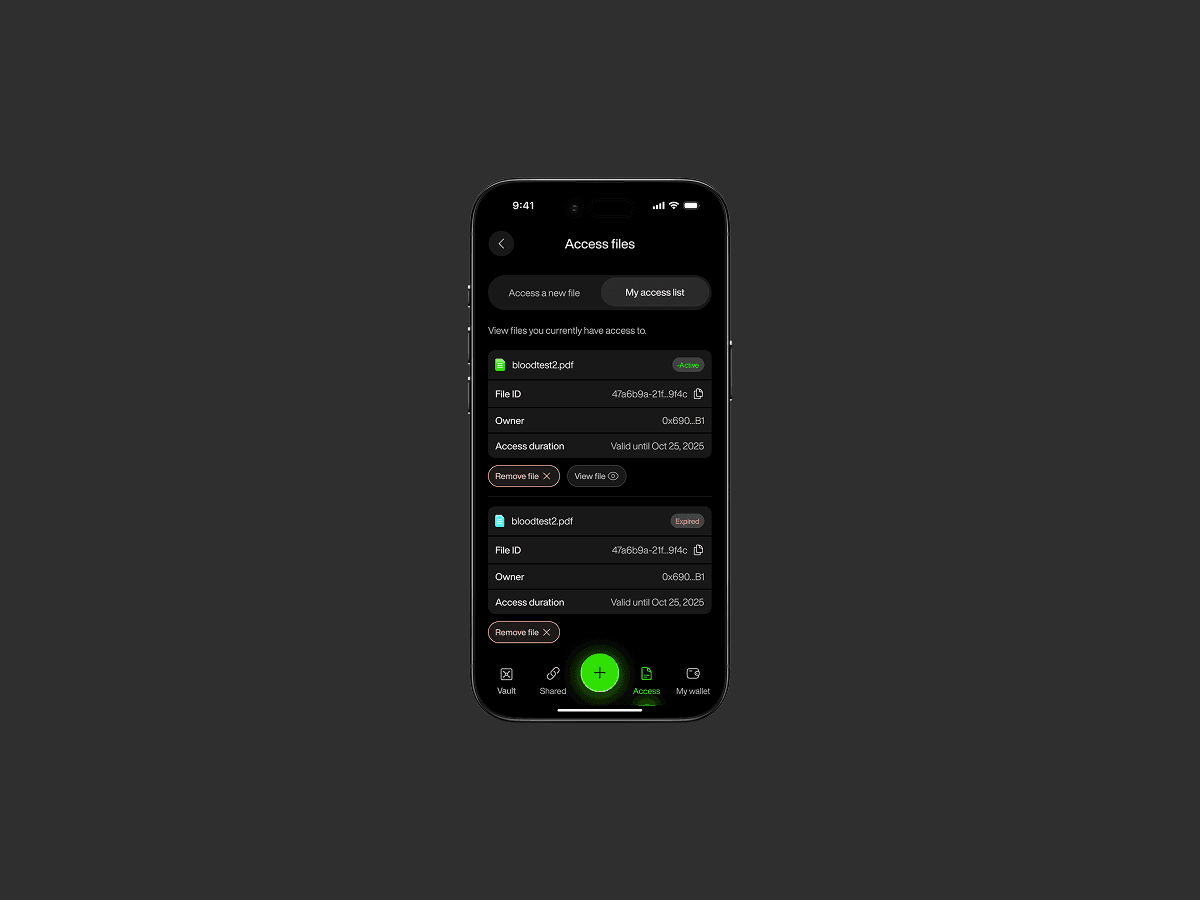
07My access list
The owner has a vault; the recipient has an access list. It separates active from expired grants, so a user can see at a glance what they can still open and what has lapsed.
Each entry shows the File ID, the owner's address, and the access duration — which is what makes the trust model concrete rather than a claim in the marketing copy.
Outcomes and learnings
DataVault took 2nd place at the hackathon and, more usefully, started the conversation we wanted about the future of Web3 data security. The judges called out the clean design, the intuitive flow, and the scalability of the model across healthcare, finance, and AI data training.
It stands as a proof of what happens when user experience meets blockchain rather than fighting it.
Learnings
- Human-centred design is the unlock for mainstream Web3 adoption — the cryptography was never the hard part.
- Repeated testing and micro-interactions make or break trust in a decentralised product.
- Team synergy and iteration speed are the real weapons in a high-pressure build.